Seven Weeks after Pesach:
Shavuot,
the Feast of Weeks - Pentecost!
Birgit Barandica, April 2009"From the day after the Sabbath (within Pesach), the day you brought the sheaf of the wave offering, count off seven full weeks. Count off fifty days (49 + one) up to the day after the seventh Sabbath, and then present an offering of new grain to the LORD" (Leviticus 23:15-16).
The biblical feasts comply with the biblical moon calendar. Hence, the feast is immoble, for it always goes by Pesach. In that we are using the Gregorian calendar since the 16th century (a change that began with emperor Constantine), it came to time shiftings. For example, this year 2017, Shavuot and the Christian Pentecost coincide on the same date.
"Count off..." - this goes from the Feast of the First Fruits, the day after the Shabbat following the Pessach Seder (Resurrection Day). Then, the counting of the fifty days begins, which is called the counting of Omer and as to the biblical-Jewish calendar ends on 6th Siwan, on Shavuot, which is the actual end of Pessach. It is the 2nd of 3 pilgrimmage feasts and also the 2nd of 3 harvest feasts. This time, it is about wheat. The crop was not to be used until the firstfruit was offered to God as a thank you for His provison. But Shavuot is by far more than "just" a harvest feast!
Yet actually, both feasts should always be held together as they are one and the same, as we will yet see in this article! The first day of the counting of the Omer is the feast of the First Fruits, which is also Yeshua's Resurrection (as "the firstfruits of those who have fallen asleep", 1 Corinthians 15:20). It is the day where God commanded to begin with the counting of the Omer (read the scripture verse on top of this article). You can read a more detailed article on how this seperation came about here, Urgency of our time.
Harvest feast - provision for the bodily
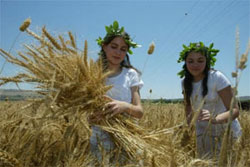
"Count off seven weeks from the time you begin to put the sickle to the standing corn. Then celebrate the Feast of Weeks to the LORD your God by giving a freewill offering in proportion to the blessings the LORD your God has given you. And rejoice before the LORD your God at the place he will choose as a dwelling for his Name (until the year 70 AD, this was the Temple in Jerusalem) - you, your sons and daughters, your menservants and maidservants, the Levites in your towns, and the aliens, the fatherless and the widows living among you. Remember that you were slaves in Egypt, and follow carefully these decrees", (Deutoronomy 16:9-12).dressed in white and with flower wreaths parade through the streets that are also decorated!
How good are God's decrees! Everyone shall have the possibility to celebrate this feast! It consists out of several components: Here, it is about the 1) physical provision. This is why we are to celebrate CHEERFULLY, with our family, extended family, acquaintances, friends, even with our employees, the poor and foreigners!
Today, synagogues, congregations and private houses are being festively decorated with flowers, green branches and fruits. Children
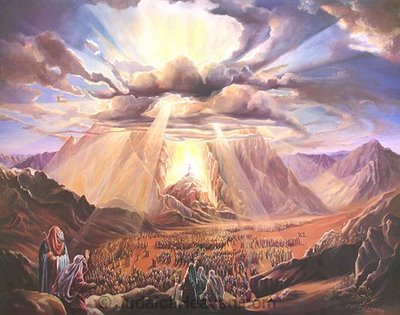
Mount Sinai with fire and quakes and loud shofar blasts and gave His instructions, His Torah, to His people. They heard His voice very clearly and decided for themselves, if they wanted to follow the Almighty. And they said YES!: "So Moses went back. He sent for the elders of the people. He explained to them everything the Lord had commanded him to say. All of the people answered together. They said, “We will do everything the Lord has said.” So Moses brought their answer back to the Lord" (Exodus 19:7-8). This was the moment of the birth of Judaism!
Revelation Celebration or the Feast of the Giving of the Torah:
Then it is about another important point in this feast: "... man does not live on bread alone but on every word that comes from the mouth of the LORD" (Deutoronomy 8:3). Shavuot being a Harvest Feast is also 2) the giving of Torah - theWord of God! So on this day, Jews celebrate the reception of the Torah on Mount Sinai, 50 days after the exodus from Egypt, (Exodus 19), through which God revealed Himself to them. This is why symbolically. there are 50 days between the two feasts.
According to Jewish tradition, a whole night is spent studying scriptures during this feast (remember the days being on the eve). People remember how it was when God came down onto
The Almighty wants to be the God of all mankind!
And also, the book of Ruth is being read, for the conscious dedication of the non-Jewish Moabitan Ruth to the God of Israel fits the Feast of the Torah perfectly well - it is a "first fruit" among many Gentiles that followed her example in the following centuries. When back then, her mother-in-law Naomi wanted to return to her home place near Bethlehem, after her husband and both her sons had died, Ruth was not dissuaded to accompany Naomi: "Your people will be my people. Your God will be my God" (Ruth 1:16), she said and Naomi understood the sincerity of her beloved daughter-in-law.As to Leviticus 23, the chapter where God declares all of His feasts valid for all generations for all times (there is no contrary mentioned in all of the New Testament), two leavened breads made from the first fruits of the wheat harvest were to be given as a wave offering (so before everything else, thankfulness is due to Him who made everything grow!). Leavened dough increases and so these two breads are a symbol for foreigners and Jews who, together, have become an increasing unity!
For believers in Yeshua (Jesus) these breads are a symbol for Messianic Jews and non-Jews who, together, have become an increasing unity through the Holy Spirit!
The following detail is amazing: in Hebrew, the Ten Commandments are called "Ten Words" (Aseret haDevarim). They, together with several other commandments form God's instructions, His Torah - the same as the first five books of the bible are called "Torah" - they are the word of God! As to John 1:1, this Word is Yeshua... in other words: Yeshua is Torah!!!
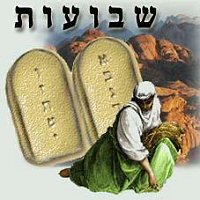
At Mount Sinai, God wrote His words on two stone tablets. Later, through the prophet Ezekiel, He told His people that He will replace their stony hearts (which became hard through idolatry) by a fleshly heart (which willingly submits to Him out of love; Ezekiel 11:19). This happened at Shavuot, when He wrote His Word onto the hearts of the believers (Hebrews 8:10)!
Like this, the falling of the Holy Spirit on Shavuot on those who believe in Yeshua, is reason #3 for thos feast!
Yeshua, as the first person to ever be resurrected, is the First Fruit! In the meantime, He had returned to His Father (Ascention Day) and has now sent His Spirit to those believing (Acts 1:8), who enables them until the time Yeshua returns!
In all biblical feats you can see a certain pattern - they consist of three parts. The first part being kind of a review on what God YHWH (God) in His mercy, has already done in the past for His people. On Pesach, for example, it is about the deliverance from slavery in Egypt. It was a deliverance out of pur love and mercy, for the people had done nothing to deserve it - they could not do anything to receive it. They lived in Egypt for a very long time, 400 years, without caring much a bout God. And yet He deliverd them from this captivity! Like this it is also, when we dedicate our lives completely to Yeshua: without our assistance, we also will be delivered from slavery of a life in seperation from Him!
In the second part, we turn a little bit and look at our respective presence. Or, like on this particular Shavuot, at a very specific point in time. If, for example, we remember, how JHWH gave His intructions to His people at Mount Sinai, then we see that He did not give them before salvation, as to the motto, "Okay, first you will have to prove yourself to me. You will have to fulfill my ordinances, and then will I see if I deliver you... No, the deliverance came completely without our works! Yet then begins the way and for that, God equips us! So the third part refers to the equipping: the Holy Spirit was poured out! And therefore, this second Part can also be a reflection on where we are standing in our own life!
Then we turn a little bit further and look into the future. By the pouring out of the Holy Spirit, something had visibly taken place - the empowerment of the followers of Yeshua, ultimately always aiming at more and more people to the end of the earth, coming to faith by hearing of the Good News, the Word of God and what Yeshua had done for all of us, knowing that He will return, at a particular point in time!
A real good reason to celebrate cheerfully, I would say!!!
Background information
This word Shavuot is the plural form of Shavua (= week) and is therefore also called Feast of Weeks. The word Pentecost derives from the greek pentekosté, meaning "fiftieth" (day). So it is the same time frame, no matter if you count Omer in weeks or days, in Hebrew or Koiné-Greek (in verse 15 of Levitikus 23, God speaks of "seven weeks" and in the next verse, He speaks of "50 days"). The counting of Omer shows the same godly expectancy like for example the Advent Calendar, waiting for Christmas. With the difference that the Advent counting has no biblical foundation.So it is the same two words or names for the same feast! Tragically, three centuries later, they were converted into two different feasts by emperor Constantine who made the calendar be re-calculated. He wanted to take everything Jewish out of the bible... Shavuot and all other biblical feasts were left in the Jewish calendar, while Christian feasts (like Christmas, Easter, etc. and also Pentecost which now became a feast for the birth of the church...), which he had in the meantime introduced, "Pentecost" was taken into the new calculation that led into the Gregorian calendar we are using now.
Like this though, the original meaning of the feast is lost nowadays and cannot be seen anymore in Pentecost as we know it today, where it is widely known only as the "birth of the church", which like this, has nothing at all to do with the requirements of God mentioned in Leviticus 23... You cannot see how the feast came about, what led to it. The way, we are educated since then, makes us think that everything began here, and what happened before is not important to us anymore... What a terrible mistake!
Yet Shavuot (the original Pentecost) found its Messianic fulfillment in the outpouring of the Holy Spirit and not in the "birth" of a church! In Acts 1:4-5, Yeshua Himself instructed His (Jewish) desciples, "Do not leave Jerusalem, but wait for the gift my Father promised, which you have heard me speak about. For John baptised with water, but in a few days you will be baptised with the Holy Spirit." And in verse 8, He went on to say, "... you will receive power when the Holy Spirit comes on you; and you will be my witnesses in Jerusalem, and in all Judea and Samaria, and to the ends of the earth."
He said all this in compliance with what His Father had announced before through His prophet in Ezekiel 36:27, "And I will put my Spirit in you and move you to follow my decrees and be careful to keep my laws."
Wow - and how the Holy Spirit fell (Acts 2)!!! Since then, He not only teaches us, but He also empowers us in our relationship toward God and among each other (1 Corinthians 12+14). And this refers to all who believe in Yeshua: Jews and Non Jews!
You can see a parallel between the fire which back then fell on Mount Sinai and the fire that fell at Shavuot in Jerusalem. Both times, God came down to His people: at Sinai, in order to write His Words on two stone tablets (His Torah) for His people and in Jerusalem in the form of His Spirit in order to write His Word (His Torah) into the hearts of His people. The Good News was to go forth as from then on "to the ends of the earth" (Acts 1,8 referring to Psalm 19:4). Here, it also opened up for the non-Jews, but it was not meant to seperate from its origins, which unfortunately did happen...
Second Pilgrimage Festival
Next to Pessach, Shavuot is the second major pilgrimage Festival of the Bible. Even nowadays, Jews from all over the world are flocking to Jerusalem on the three major feasts, Pessach, Shavuot and Sukkot (Feast of Tabernacles). Noticeably, more and more Christians are joining them (as can be seen particularly on Sukkot).
Because of the pilgrimage feast back then, "there were staying in Jerusalem God-fearing Jews from every nation under heaven" (Acts 2:5). The city was literally bursting at the seams! Really, God knows exactly what He is doing: before the very eyes of thousands from everywhere, he poured His Holy Spirit out over the believers!
Up to that point, there had never been such a big demonstration of Himself! And what effects did this cause! A roar as of a big storm could be heard and also felt. Fire that didn't consume anything, came down and could be seen on the heads of the believers (reminds a bit of the burng bush, doesn't it?). The disciples began speaking in languages they didn't know, but the foreign Jews understood them, as those languages were their own, and they couldn't grasp anything that was going on. There were various manifestations of the Holy Spirit so that people thought that the disciples were drunk...! Yet I guess, they never had a clearer mind than at THAT particular point in time!!!
Peter, who up to that point was a robust, coarse person, who at times also put his foot in his mouth, became a great preacher from that moment on. He held his first great speech here in this chaos with the result that on this very day alone, on Shavuot, 3000 people came to faith in Yeshua (Acts 2:14-41)! Meditate on this a bit - it is so fantastic!
The church grew fast, even outside of Jerusalem and in the whole world known at that time, for the foreign Jews took the experiences of this very specific Shavuot back to their homelands, where they spoke enthusiastically of it, which made many more people come to faith in Yeshua.
Unfortunately, not only the number of believers grew, but also the number of those denying Yeshua and His followers, and tried to shut them up. Up to this present day, there are many persecutions ... and I am not talking of a mere Christian persecution, as bad as it is, but first and foremost I am relating here to the persecution of Jews, which ultimately led to this desatrous Replacement Theology, by which many of us are still being marked and which in turn sparked the Christian antisemitism, leading to many horrible pogroms during the centuries, ultimately ending in the desastrous Holocaust. (Let me remind you once again of my article Urgency of our Time.)
So Shavuot is a very good opportunity for Christians to get aware of our Jewish-Hebraic faith roots, taking healthy consequences.
~~~~~~~~~~~~~~~~~~~~~~~~~~~~~~~~~~
Tradition - dairy dishes
Every Jewish feast has its traditional dishes. Shavuot would be unthinkable without its great varieties of cheese cakes and other dishes (scroll down a bit to the recipes) of milk products! This custom is being explained in different ways. Thus, school kids learn that in the beginning, the Israelites consumed only dairy products in order to be on the safe side, because the Torah still was very new and the individual laws had not been known yet. So it wasn't clear as to how the nowaday's most meticulously observed seperation of meat and milk should be considered in detail.Others look at the dairy dishes as a symbol for the seperation of all "fleshly", which was to be executed in connection with the golden calf (Exodus 32). If transferring Solomon's Song of Songs to one's relationship with God, one could take dairy dishes thinking of the verse "milk and honey are under your tongue" (Solomon's Song of Songs 4:11). Still others point to the fact that the numeric value of the Hebrew word "chalav" (milk) is 40: Moses spent fourty days on Mount Sinai.
In this spirit:
Chag Shavuot Sameach - Have a happy Shavuot!